PROPYLENE CAS#115-07-1
Essential Petrochemical Feedstock – Propylene is one of the most important organic chemical raw materials after ethylene and benzene, serving as a key building block for numerous downstream chemical products.
Excellent Chemical Reactivity – Its carbon-carbon double bond enables a wide range of addition reactions and polymerization processes, making it highly versatile in chemical synthesis.
Broad Industrial Applications – Widely used in the production of polypropylene, acrylonitrile, propylene oxide, acetone, ethylene-propylene rubber, and many other high-value industrial chemicals.
Versatile Material Production – Supports the manufacture of synthetic resins, synthetic rubbers, synthetic fibers, and engineering plastics, meeting the needs of diverse industrial sectors.
Products Description of Propylene
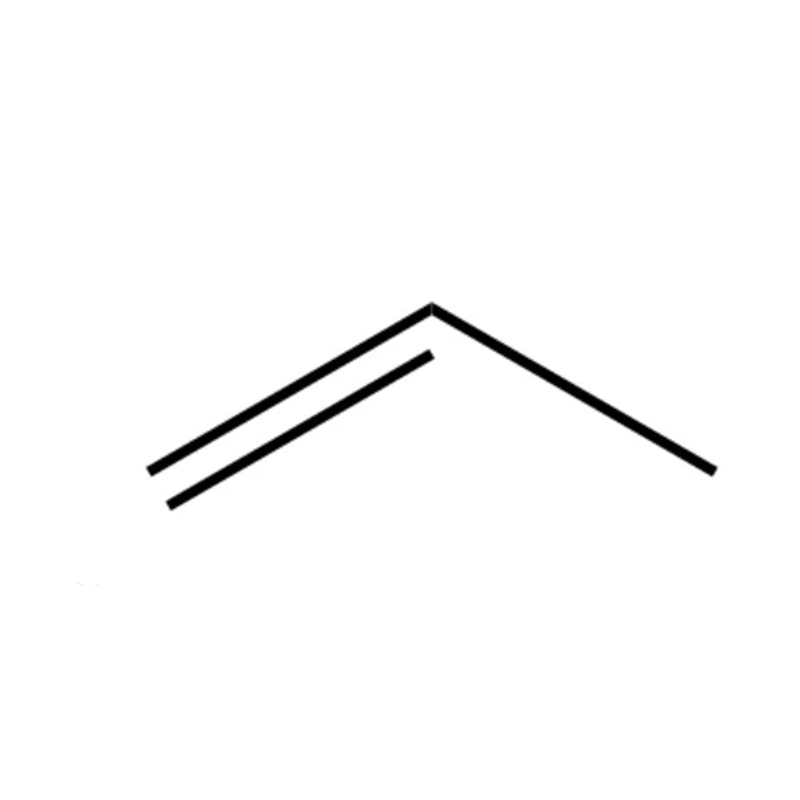
Propylene is the second simplest member of the olefin family, with the structural formula CH₂=CHCH₃. It is one of the most important organic chemical feedstocks after ethylene and benzene. Propylene is typically recovered from gases generated during thermal cracking and catalytic cracking processes and is also obtained as a byproduct of ethylene production from light oil cracking.
Its molecular structure contains an unsaturated carbon-carbon double bond, enabling it to undergo addition reactions with hydrogen, halogens, and hydrogen halides, as well as addition polymerization. Propylene serves as a key raw material for the production of acrylonitrile, polypropylene, ethylene-propylene rubber, propylene oxide, acetone, and other synthetic resins, as well as synthetic rubber, synthetic fibers, and plastics.
| Melting point | -185 °C(lit.) |
| Boiling point | -47.7 °C(lit.) |
| Density | 1.49 |
| Vapor density | 1.48 (vs air) |
| Vapor pressure | 15.4 atm (37.7 °C) |
| Refractive index | 1.3567 |
| Flash point | -108°C |
| Acidity coefficient (pKa) | 43(at 25°C) |
| Form | colorless gas |
| Explosion limits | 11.10% |
| Odor threshold | 13ppm |
| Water solubility | 0.33g/L(25 °C) |
| Thermal conductivity | 0.11 W/(m-K) |
| Freezing point | -185.25℃ |
| Merck | 137,941 |
| BRN | 1696878 |
| Henry's Law Con stant | 5.6x10⁻⁵ mol/(m3Pa) at 25℃, Plyasunov and Shock (2000) |
| Dielectric constant | 1.9 (20℃) |
| Stability | Stable. Highly flammable. Easily forms explosive mixtures with air. Incompatible with strong oxidizers, strong acids, and halogens. |
| InChI | 1S/C3H6/c1-3-2/h3H,1H2,2H3 |
| InChIKey | QQONPFPTGQHPMA-UHFFFAOYSA-N |
| SMILES | CC=C |
| LogP | 1.77 at 20℃ |
Product Application of Propylene
Propylene is an essential raw material in the chemical industry and serves as a key feedstock for the production of numerous downstream chemicals. Through gas-phase oxidation, propylene is converted into acrolein, which is further used to manufacture acrylic acid, allyl alcohol, glyceraldehyde, hydroxyacetaldehyde, and the important food and feed additive methionine.
Ammonia oxidation of propylene produces acrylonitrile, an important raw material for the manufacture of synthetic fibers, synthetic rubber, and plastics. Chlorination of propylene yields chloropropylene, which can be further converted into allyl alcohol, propylene dichlorohydrin, chloropropionitrile, and other intermediates used in the production of glycerin, epoxy resins, chlorohydrin rubber, and surfactants.
Through alkylation, propylene is used to produce cumene, the primary intermediate for phenol production, with acetone generated as a valuable co-product. Oxo synthesis of propylene produces n-butyraldehyde and isobutyraldehyde, which serve as important intermediates in the manufacture of plasticizers, dyes, solvents, pesticides, and other organic chemicals.
In addition, hydration of propylene produces isopropyl alcohol, which is further used to manufacture acetone, isopropylamine, and isopropyl esters. Propylene can also undergo dimerization, trimerization, polymerization, and tetramerization to produce valuable products such as ethylene, propylene trimers, polypropylene, and dodecene, the latter being an important intermediate for surfactant production.