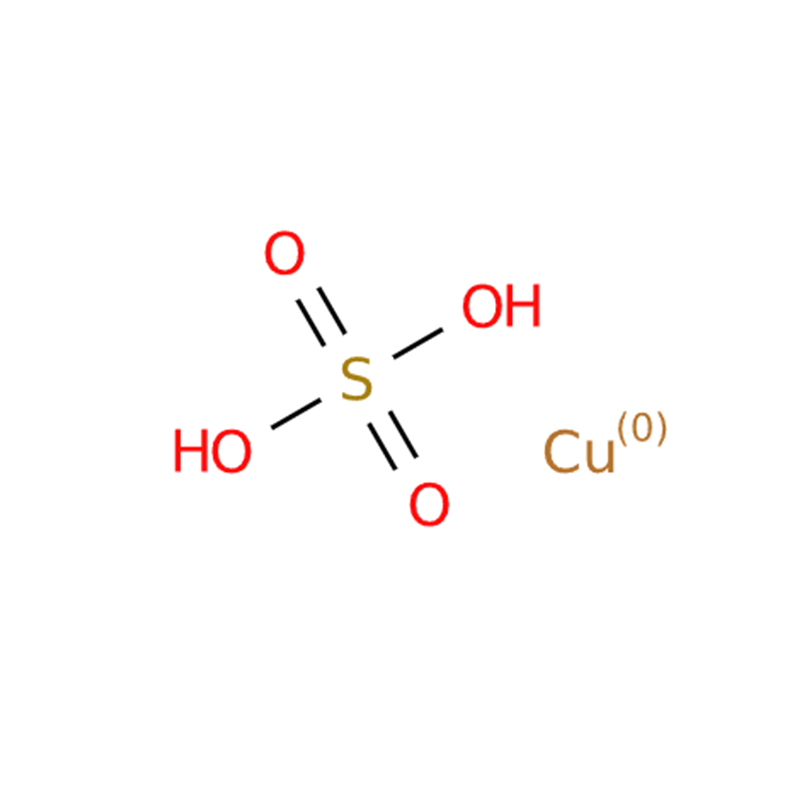
Copper(II) sulfate CAS#7758-98-7
Excellent Water Solubility – Copper sulfate is a soluble copper salt that dissolves readily in water, with a solubility of approximately 23.05 g/L at 25°C, forming a characteristic blue solution.
Stable Physical Properties – Copper sulfate is highly stable under normal room-temperature and pressure conditions. It does not readily deliquesce and can gradually weather in dry air, supporting convenient storage and handling under suitable conditions.
Strong Pathogen-Control Properties – The hydrolyzed aqueous solution is weakly acidic and exhibits strong pathogen-killing activity, making copper sulfate widely used in aquaculture for the prevention and treatment of fish diseases.
Broad Industrial & Laboratory Applications – Copper sulfate is used to produce various copper salts, refine copper, prepare Bordeaux mixture, and support laboratory applications such as water detection and protein concentration determination.
Products Description of Copper(II) Sulfate CAS#7758-98-7
Copper sulfate is an inorganic compound widely used in the inorganic chemical industry as a raw material for the production of other copper salts, including cuprous chloride, cupric chloride, copper pyrophosphate, cuprous oxide, copper acetate, copper carbonate, and others.
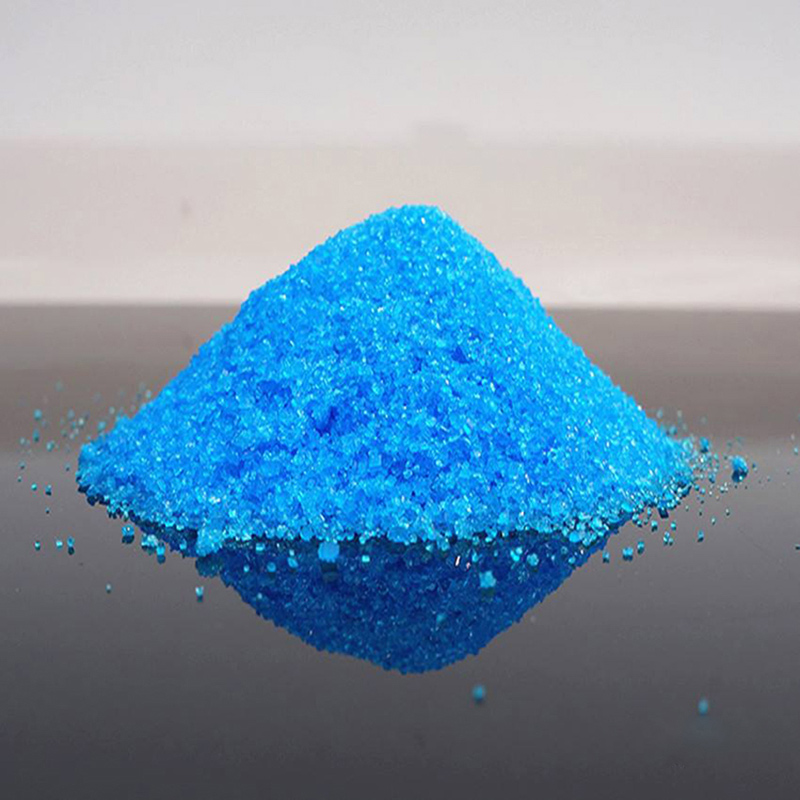
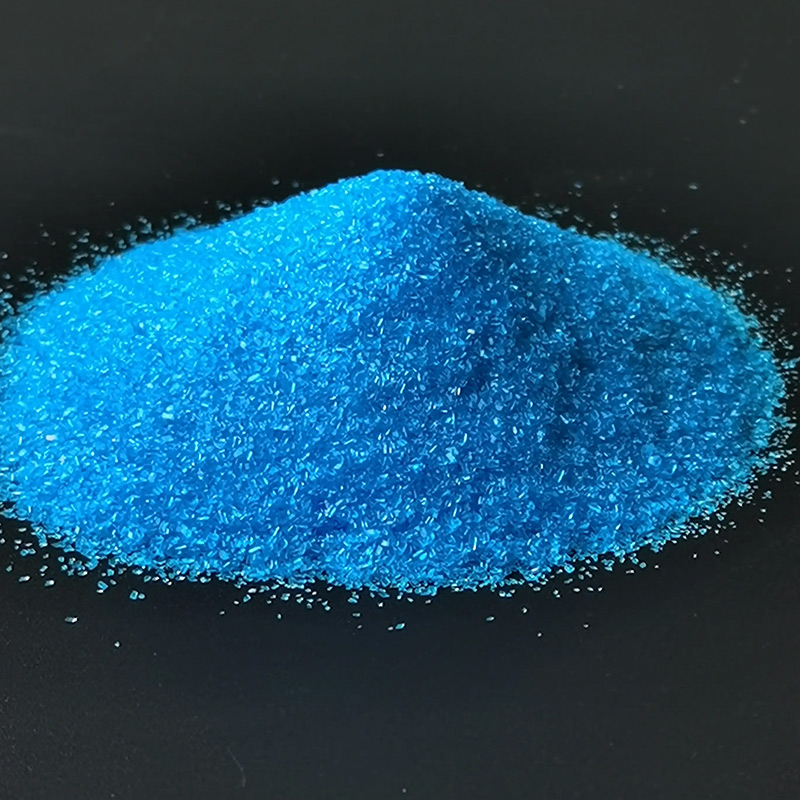
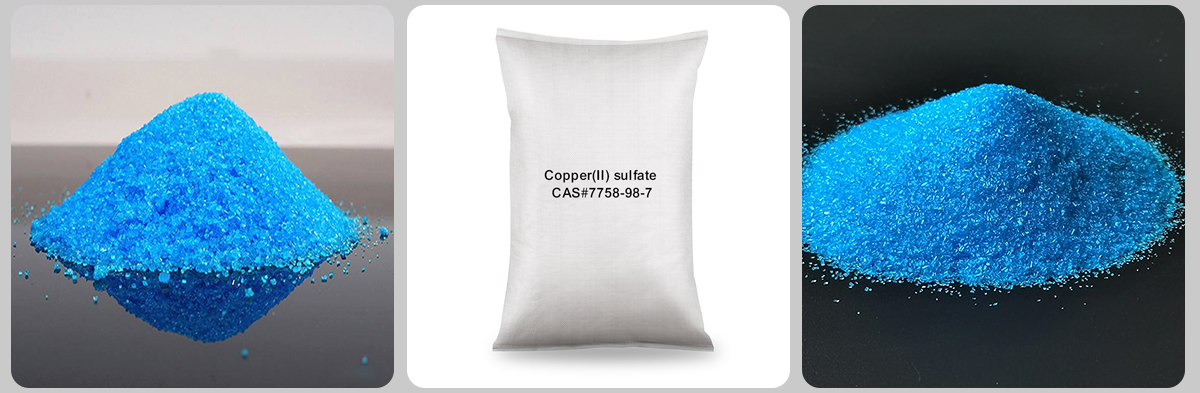
Copper sulfate commonly occurs in crystalline form. Anhydrous copper sulfate is a white crystalline powder, although it may appear light gray-green due to impurities. It is a soluble copper salt with a relative density of 3.603 and a water solubility of approximately 23.05 g at 25°C. It is insoluble in ethanol and ether but readily soluble in water, producing a characteristic blue aqueous solution. Copper sulfate is a salt of a strong acid and a weak base, and its hydrolyzed solution is weakly acidic and exhibits strong pathogen-killing properties.
Copper sulfate is widely used in aquaculture for the prevention and treatment of fish diseases. When its solution is concentrated and crystallized, blue crystals of copper sulfate pentahydrate are obtained, commonly known as gallstone, stone gall, copper sulfate, or blue vitriol. Copper sulfate pentahydrate is toxic, odorless, and has a metallic, astringent taste.
Copper sulfate is highly stable under normal temperature and pressure conditions. It does not readily deliquesce but gradually weathers in dry air. When heated to 45°C, it loses two molecules of crystal water; at 110°C, it loses four molecules of crystal water; and at 150°C, it loses all of its crystal water and becomes anhydrous copper sulfate. The anhydrous compound can absorb water and be converted back into the hydrated form. At approximately 650°C, copper sulfate decomposes into copper oxide and sulfur trioxide.
The blue color of copper sulfate aqueous solutions is caused by hydrated copper ions. This characteristic is commonly used in laboratory applications to test for the presence of water. In practical production and agricultural applications, copper sulfate is used in copper refining and can be mixed with slaked lime to prepare Bordeaux mixture, a widely used pesticide.
The copper ions in copper sulfate can disrupt the three-dimensional structure of proteins and cause protein denaturation. In protein concentration determination, an alkaline solution is often added to the protein sample, followed by the addition of copper sulfate solution. The solution then turns purple, and this reaction is known as the biuret reaction.
Copper sulfate is a heavy metal salt and is toxic. The stated lethal dose for adults is 0.9 g/kg. In the event of accidental ingestion, the source recommends consuming large amounts of protein-rich foods such as milk and egg white, or using calcium disodium EDTA for detoxification.
Copper(II) sulfate Chemical Properties
| Melting point | 200 °C (dec.)(lit.) |
| density | 3.603 g/mL at 25 °C(lit.) |
| vapor pressure | 7.3 mm Hg ( 25 °C) |
| storage temp. | Store at +5°C to +30°C. |
| solubility | H2O: soluble |
| form | powder |
| Specific Gravity | 3.603 |
| color | Slightly greenish to gray |
| PH | 3.5-4.5 (50g/l, H2O, 20℃) |
| Odor | odorless |
| PH Range | 3.7 - 4.5 |
| Water Solubility | 203 g/L (20 ºC) |
| Sensitive | Hygroscopic |
| Merck | 142653 |
| Dielectric constant | 10.3(0.0℃) |
| Exposure limits | ACGIH: TWA 1 mg/m3 |
| NIOSH: IDLH 100 mg/m3; TWA 1 mg/m3 | |
| Stability: | hygroscopic |
| InChIKey | ARUVKPQLZAKDPS-UHFFFAOYSA-L |
| CAS DataBase Reference | 7758-98-7(CAS DataBase Reference) |
| NIST Chemistry Reference | Cupric sulfate(7758-98-7) |
| EPA Substance Registry System | Cupric sulfate (7758-98-7) |
| Hazard Codes | Xn,N,Xi |
| Risk Statements | 36/38-50/53-22-51/53-36/37/38 |
| Safety Statements | 24/25-36-60-61-22-26 |
| RIDADR | UN 3288 6.1/PG 3 |
| WGK Germany | 2 |
| RTECS | GL8800000 |
| F | 3 |
| TSCA | Yes |
| HS Code | 2833 25 00 |
| HazardClass | 6.1 |
| PackingGroup | III |
| Hazardous Substances Data | 7758-98-7(Hazardous Substances Data) |
| Toxicity | LD50 orally in Rabbit: 481 mg/kg |

Product Application of Copper(II) Sulfate CAS#7758-98-7
Copper sulfate can be used as a fungicide. When mixed with lime water, it forms Bordeaux mixture, which is used to control fungal diseases on crops such as lemons and grapes. Dilute copper sulfate solutions can also be used to sterilize aquariums and control snails. Since copper ions are toxic to fish, the concentration and dosage must be strictly controlled. Most fungi can be effectively controlled with relatively low concentrations of copper sulfate.
Copper sulfate can also be used to control Escherichia coli. Its aqueous solution has strong bactericidal properties and is mainly used in agriculture to prevent and control various diseases affecting fruit trees, malt, potatoes, rice, and other crops. It can provide good control of certain diseases, although its effectiveness against rust and powdery mildew is relatively limited. Copper sulfate may also cause phytotoxicity, so it is generally used only on crops with strong tolerance to copper ions or on dormant fruit trees.
Copper sulfate is primarily used as a preventive fungicide and should generally be applied before disease occurs. It can also be used to control algae in rice fields and ponds.
In addition to its pesticidal applications, copper sulfate serves as a trace-element fertilizer. It can help maintain chlorophyll stability, prevent premature chlorophyll degradation, and promote copper absorption by crops. Copper deficiency can cause crops to lose their green color, while copper deficiency in fruit trees may result in small fruits and harder flesh. Severe copper deficiency may eventually cause fruit trees to die.
Crops that are sensitive to copper include cereals such as wheat, barley, and oats. Copper sulfate is mainly used for seed treatment and foliar fertilization to provide supplemental copper to crops.